
When someone arrives with persistent pain, the place where they feel it is an important part of their story. It is not necessarily the place where the problem began, and it is rarely the only place worth observing.
In 2019, Santa Monica Mirror featured Beth, a longtime yoga and meditation practitioner who had experienced lower-back and sciatic pain for approximately twelve years following abdominal surgery. Standing and walking had become uncomfortable. Her story offered an opportunity to discuss something that has remained central to my work: movement and recovery must be considered in the context of the whole person.
Looking beyond the area of pain
Abdominal surgery, for example, can affect much more than the muscles of the abdominal wall. The healing process can involve scar tissue at the visible incision and within deeper layers of tissue. Internal adhesions may develop as part of healing and inflammation, potentially limiting how tissues move or glide in relation to one another.
Fascia, muscles, and connective tissues around internal structures normally need to accommodate movement together. When scarring or adhesions limit that mobility, they may influence how forces are transmitted through surrounding tissues. Depending on their location and extent, restrictions can also involve areas near nerves and blood vessels.
Muscles are only one layer of this interconnected system. Changes in tissue mobility and tension may affect how someone organizes movement and distributes mechanical loads through the pelvis, spine, and elsewhere. Previous injuries, surgeries, or other sites of scarring can make an already complex picture more complicated.
Movement is not simply an exercise
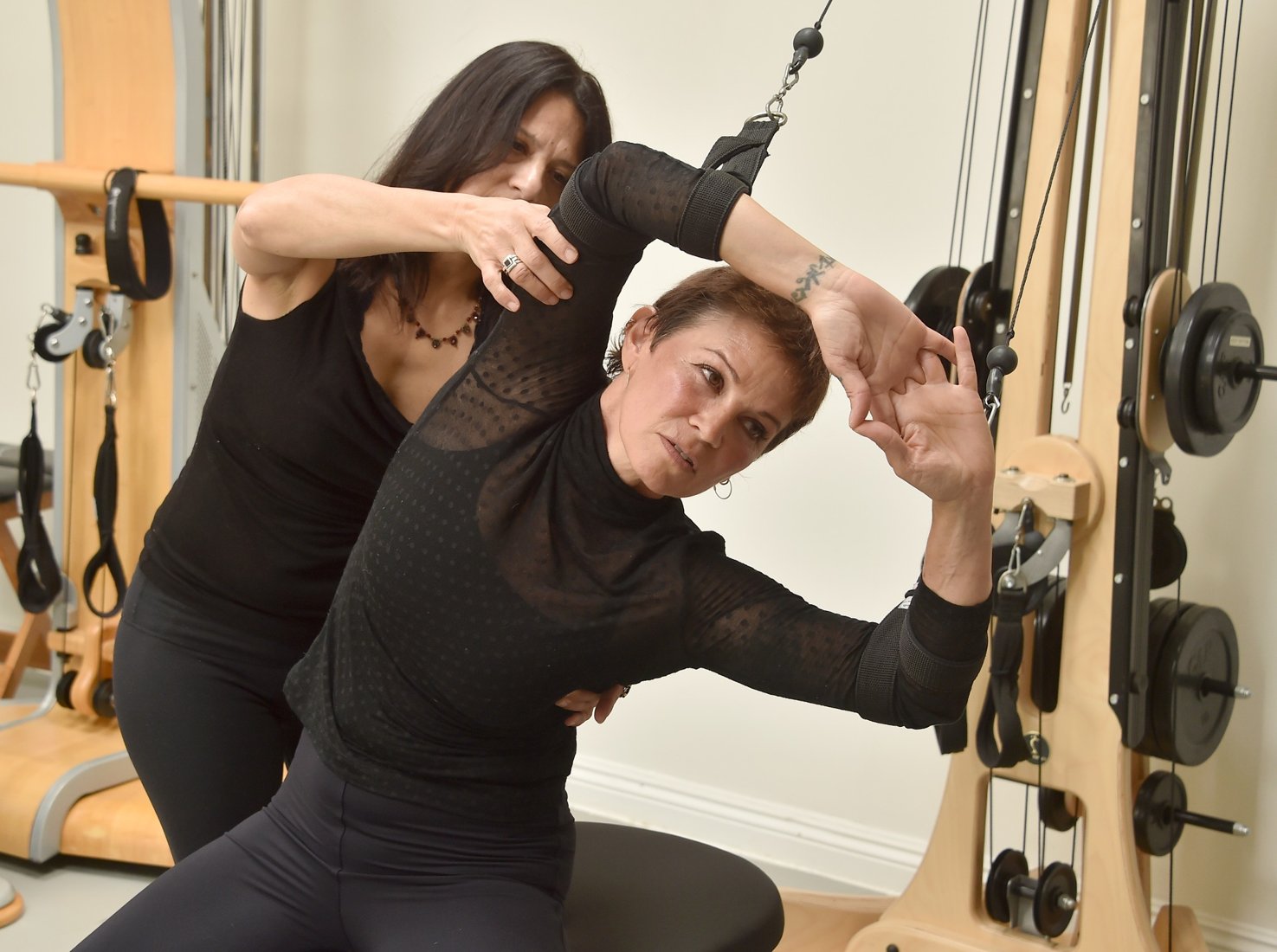
When working with someone experiencing longstanding limitations, I pay attention to relationships: how the pelvis and spine organize, where unnecessary effort appears, whether breath and movement can become more coordinated, and what changes when the person finds better support.
My approach draws on many years of movement education and hands-on practice, including GYROTONIC® and GYROKINESIS® movement principles. A technique or piece of equipment is not the entire method. The purpose is to help a person discover more functional ways of moving and gradually make those possibilities accessible outside a session.
With Beth, the process involved guided movement and progressive changes in how she could move and participate. The focus was not simply to perform more exercises, but to improve the organization and experience of movement itself.
Creating change is only the beginning
One of the questions I return to in my work is: How will a person know that something has changed? Sometimes a change is obvious—a movement becomes more comfortable, or a familiar position feels different. Sometimes it is subtle and needs to be observed more carefully.
I often invite clients to compare how they stood, reached, walked, or felt before and after a session. Photographs or simple movement comparisons can help when used appropriately and with the person's agreement. Just as important are the questions we ask: Where do you feel the difference? Which movement requires less effort? Can you recognize the change without someone pointing it out?
These questions are not merely documentation. They are part of learning. Recognition invites participation, builds awareness, and helps a person begin to understand what might allow a useful change to continue.
Learning to maintain what improves
My goal is not to create a long list of exercises a person must perform forever. It is to identify a few effective, manageable actions that a person can understand and use independently when they are needed.
Many of the tools I teach are intentionally simple. Clients learn how to prepare an area, reduce unnecessary tension, support a more useful movement pattern, and recognize when they have achieved a change worth maintaining. Over time, those skills can become part of everyday movement rather than a separate, complicated routine.
In my practice, I have repeatedly observed that clients who can identify their improvements and participate in maintaining them often become more confident in using what they have learned. Progress is individual, and no method guarantees the same outcome for everyone.
A different measure of progress
Reducing discomfort matters. So does the ability to stand, walk, bend, or return to meaningful activities with more ease. But another important outcome is the person's growing capacity to notice, respond to, and sustain improvements without depending on constant direction.
The larger purpose of Body Rhythm is to connect restoration with education: helping each person develop a more functional relationship with movement and a more independent role in their own progress.
Create change. Recognize it. Integrate it. Learn to maintain it.
This reflection revisits themes from the 2019 Santa Monica Mirror feature, “Relieving Sciatic Nerve Pain with Shevi at Body Rythm” ↗.
Photograph: a Body Rhythm movement demonstration; the person pictured is not identified as Beth. This article describes professional observations and educational principles, not an assessment or diagnosis of an individual reader.